


Spindle bearing failure: 4 Keys to Prevent It
Why Spindle Bearing Failure Threatens Your Production Line
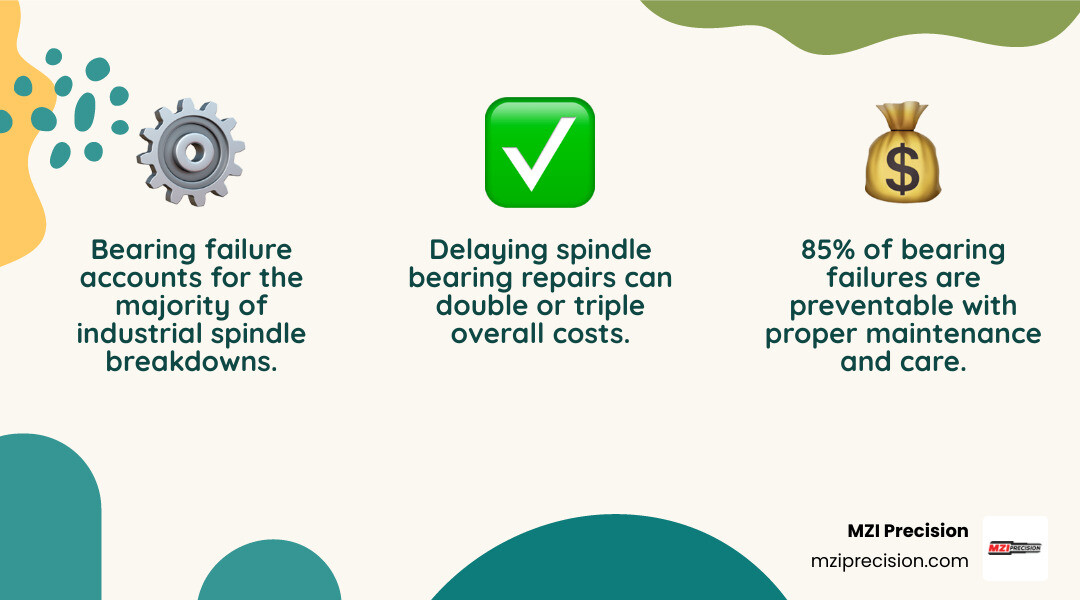
Spindle bearing failure is the leading cause of unplanned downtime in industrial manufacturing, accounting for most spindle breakdowns across CNC machining centers, grinding equipment, and high-speed production lines.
Key Facts About Spindle Bearing Failure:
- Primary cause: Bearing failure is responsible for the majority of spindle breakdowns
- Average lifespan: Most spindles operate between 5,000-7,000 hours before bearing replacement
- Cost impact: Delaying repairs can double or triple repair costs
- Prevention rate: 85% of bearing failures are preventable with proper maintenance
- Warning signs: Increased noise, vibration, temperature, and poor surface finish quality
Manufacturing facilities depend on precision spindles to maintain tight tolerances and consistent quality. When bearings inside these critical components begin to deteriorate, the effects cascade through your entire production process.
The research shows that most spindle failures occur when the bearings fail, yet many operators miss the early warning signs. A spindle that “began making noise over two years ago” can end up costing more than double the original repair estimate when the problem is finally addressed.
Understanding the root causes, symptoms, and prevention strategies for bearing failure isn’t just about avoiding costly repairs – it’s about maintaining the precision and reliability that keeps our manufacturing operation competitive.
The Root Causes of Spindle Bearing Failure
When your precision spindle shows signs of trouble, it’s rarely a single event. More often, it’s a combination of factors that compromise bearing integrity. Understanding these root causes is the first step toward preventing costly downtime.
How Lubrication Issues Cause Spindle Bearing Failure
Lubrication is critical for separating metal surfaces, dissipating heat, and protecting against wear. When it fails, spindle bearing failure is almost certain. Problems arise from several sources: insufficient lubricant starves bearings of protection, causing friction and heat that can soften the bearing material. Conversely, too much lubricant in high-speed spindles can churn and overheat, breaking down chemically. Using the wrong lubricant type or allowing its viscosity to break down over time also eliminates the protective film, leading to accelerated wear. As detailed in multiple peer-reviewed studies on bearing reliability, improper lubrication remains a primary path to failure.
The Silent Killer: Contamination
Contamination works invisibly, with microscopic particles acting like sandpaper on precision bearing surfaces. Over time, this gradual wear destroys the spindle’s accuracy.
Coolant ingress is a major threat, as it washes away lubricant and corrodes surfaces. This is often worsened by operators directing coolant spray at the spindle nose. Metallic particles from machining and chip contamination forced past seals act as grinding agents. Even the air supply for purge systems can introduce dust and moisture. Seal failure opens the door for all types of contaminants to enter the bearing cavity.
Operational Stress and Environmental Factors
Even with perfect lubrication and cleanliness, operational demands can push bearings beyond their limits.
- Machine crashes cause immediate, permanent indentations (brinelling) on bearing surfaces, guaranteeing future problems.
- Overloading the spindle with excessive feed rates, aggressive cuts, or heavy workpieces causes premature wear.
- Excessive speeds generate heat and vibration that accelerate bearing degradation, as research shows that parameters that operate too rapidly can cause failure.
- Tool imbalance creates constant, damaging vibration that directly attacks bearing integrity.
- Thermal expansion from rapid temperature changes can create internal condensation, rust, and stress on bearing components.
Improper Handling, Installation, and Storage
Many bearing failures trace back to mistakes made before the spindle is even run.
- Incorrect installation, such as applying force to the wrong ring, can cause brinelling and immediate damage.
- Improper fits (too loose or too tight) lead to fretting corrosion or excessive pre-loading, both of which cause premature failure.
- Misalignment of the shaft and housing concentrates stress on small areas of the bearing, causing rapid wear.
- Improper storage is another common issue. Spindles stored in humid or temperature-variable conditions can corrode. If left stationary for months, micro-welding can occur, where bearing balls fuse to the raceways. Periodic hand-rotation is essential to prevent this.
For additional guidance, consult reputable industry maintenance guides that outline proper storage, handling, and lubrication procedures.
Identifying a Failing Spindle Bearing: Symptoms and Stages
Understanding the signs of spindle bearing failure can save your operation thousands in costs and downtime. A spindle provides clear warnings before it fails completely; the key is to recognize what it’s telling you.
Early Warning Signs and Symptoms
Look for these red flags that signal your spindle needs attention:
- Increased noise: A healthy spindle has a smooth hum. Grinding, squealing, or groaning sounds indicate bearing wear.
- Excessive vibration: As bearing surfaces degrade, they become rough, causing vibration you can feel or detect with monitoring equipment.
- Temperature changes: Failing bearings generate more friction and heat. A non-contact infrared gauge can easily spot a spindle running hotter than normal.
- Poor part quality: A loss of spindle rigidity due to bearing wear directly impacts machining precision, resulting in poor surface finish, chatter marks, and out-of-spec parts.
The Four Stages of Bearing Failure
Bearings fail along a predictable four-stage path. Recognizing which stage you’re in helps you make the right maintenance decision.
| Stage | Description | Vibration Indicators | Recommended Action |
|---|---|---|---|
| Stage 1: Normal Operations | Bearings are functioning as designed, with lubrication thinning over time. | Ultrasonic frequencies (1,200K-3,600K CPM or 20k-60k Hz). | Continue production. Check lubrication levels and amend as necessary. This is the baseline for healthy operation. |
| Stage 2: Micro-Pitting | Increased friction begins, leading to microscopic pitting on raceways and rolling elements. Early signs of wear appear. | Resonance (120k-480k CPM or 2k-8k Hz). | Bearings should be replaced at the next reasonable opportunity. This is the ideal window for intervention, before significant damage occurs. Delaying past this stage can lead to substantial additional repair costs. |
| Stage 3: Increased Wear | Visible imperfections appear on bearing surfaces. Wear accelerates, and noise/vibration become more pronounced. | Harmonic frequencies and sidebands become prominent. | Shut down critical equipment for immediate bearing replacement. Non-critical equipment should also be replaced promptly. Operating past this stage risks severe damage to the spindle and potentially other machine components. |
| Stage 4: End of Life | Bearing is at the point of imminent catastrophic failure. Components are severely degraded, leading to extreme vibration and noise. | Reduction in standard frequencies and rise of random vibration spikes. | Immediate shutdown is required. Ideally, no equipment should ever be pushed to this stage. Operating a spindle at Stage 4 guarantees tremendous damage on the way out, ruining the spindle and potentially causing safety hazards. Repair costs will be at their maximum, and replacement may be the only viable option. |
Stage 2 is the ideal time for intervention. Acting here means a straightforward bearing replacement, avoiding the cascading damage and higher costs associated with later stages. By Stage 3, you risk damaging other spindle components. Stage 4 represents a catastrophic failure that will cause maximum damage and expense.
Using Vibration Analysis to Predict Failure
Vibration analysis allows you to diagnose bearing problems long before they become critical. The process involves using sensors to collect vibration data, which is then analyzed to identify the unique frequency “signatures” of different defects (e.g., outer race vs. inner race damage).
By trending this data over time, you can watch a defect develop and predict when failure will occur, allowing you to schedule maintenance proactively. This approach, covered extensively in academic journals on predictive maintenance, helps avoid unplanned downtime and catastrophic failures.
Extending Spindle Bearing Life: Maintenance and Prevention
The good news about spindle bearing failure is that most of it is preventable. While all bearings eventually wear out, premature failure is largely controllable. A smart approach to maintenance can add years of life to your industrial manufacturing spindles.
Best Practices for Proactive Maintenance
Preventive maintenance is far cheaper than dealing with unexpected downtime. Key practices include:
- Maintaining a clean work environment to keep metal chips, dust, and contaminated coolant away from the spindle.
- Following proper warm-up and cool-down procedures to prevent thermal stress and internal condensation.
- Performing regular filter maintenance on coolant, lubricant, and air supply systems to block contaminants.
- Conducting drawbar force checks to catch early signs of internal issues.
- Inspecting tooling regularly, as unbalanced or worn tools create damaging vibration.
- Prioritizing operator training so your team can recognize and report early warning signs.
- Managing lubrication strictly by adhering to schedules and using only specified, properly stored lubricants.
- Handling and storing spindles correctly in a controlled environment, with periodic hand-rotation to prevent micro-welding.
Research confirms the importance of factors like maintaining the proper operating temperature for spindle longevity.
Repair, Rebuild, or Replace?
When a spindle shows signs of trouble, you must decide whether to repair, rebuild, or replace it. Rebuilding is often the most cost-effective solution for high-value industrial spindles.
The spindle repair process at MZI Precision is a meticulous procedure designed to restore spindles to OEM standards. It begins with a complete disassembly and component inspection. Key steps include bearing replacement, precision balancing to eliminate vibration at high speeds, and rigorous testing to verify performance. A proper rebuild gives your spindle a second life, often for a fraction of the cost of a new unit. Delaying service can double or triple repair costs, so acting on early warning signs is crucial. You can find more info about our repair services on our site.
Choosing the Right Bearing for Your Application
Preventing spindle bearing failure begins with selecting the correct bearings. This is not a one-size-fits-all decision.
- Bearing Type: Angular contact bearings are standard for high-precision spindles, as they handle both radial and axial loads.
- Material: Ceramic balls are lighter and generate less heat, making them ideal for high-speed applications, while steel balls offer robust performance in other environments.
- Contact Angle & Preload: These factors are critical for achieving the right balance of rigidity and rotational accuracy. Incorrect preload—either too much or too little—is a common cause of premature failure.
- Load & Speed Ratings: The bearings’ load capacity and high-speed capabilities must match your application’s demands to avoid being overloaded or over-stressed.
Proper bearing selection is an investment in the long-term reliability of your spindle.
Frequently Asked Questions about Spindle Bearings
When production issues arise, questions about spindle bearings are common. Here are answers to the questions we hear most often.
What is the difference between spindle failure and spindle bearing failure?
Spindle failure refers to the breakdown of the entire spindle unit, rendering it unable to function. Spindle bearing failure is the failure of the specific components that allow the spindle to rotate smoothly.
The key distinction is that bearing failure is the leading cause of total spindle failure. When bearings fail, they often set off a chain reaction of damage to the shaft, housing, and other critical parts. Diagnosing a spindle failure almost always involves analyzing the bearings to find the root cause.
What are the consequences of ignoring early signs of bearing failure?
Ignoring early warnings like noise or vibration is a costly mistake. The consequences include:
- Multiplying Repair Costs: A simple bearing replacement can become a full spindle rebuild, doubling or tripling the cost.
- Catastrophic Damage: A bearing that fails completely can destroy the entire spindle, turning a repairable asset into scrap.
- Unplanned Downtime: Sudden failure stops production without warning, causing major disruptions.
- Poor Quality: Long before final failure, deteriorating bearings lead to out-of-spec parts and increased scrap rates.
- Safety Risks: A violent spindle failure can endanger operators and damage surrounding equipment.
- Secondary Damage: Vibration from a failing bearing can harm other machine components like ball screws and linear guides.
What is the average lifespan of a spindle bearing?
There is no single answer, as lifespan depends heavily on application and maintenance. However, industry experts estimate that most industrial manufacturing spindles operate between 5,000 and 7,000 hours before bearing replacement is needed.
This is only a baseline. Several factors determine the actual lifespan:
- Application: A high-speed spindle running at 120,000 RPM will have a shorter bearing life than a low-speed one.
- Operating Conditions: Higher speeds, heavier loads, and frequent speed changes all increase stress and reduce life. The manufacturer’s L10 life rating is a useful but theoretical benchmark.
- Maintenance Practices: Proper lubrication and contamination control can significantly extend bearing life, while neglect can shorten it dramatically.
- Environmental Factors: Temperature, humidity, and air quality in your facility all play a role.
Proactive monitoring and maintenance are the best tools for maximizing bearing life and preventing unexpected spindle bearing failure.
Conclusion: From Breakdown to Breakthrough
Understanding spindle bearing failure is the key to preventing it. Most failures are not sudden accidents but the result of preventable issues like poor lubrication, contamination, or operational stress. Your spindle provides early warning signs—increased noise, vibration, and heat—that signal a need for attention.
By recognizing the four stages of bearing failure, you can intervene at the ideal time (Stage 2) to perform a simple bearing replacement, avoiding the cascading damage and exponential costs of waiting until total failure. Predictive tools like vibration analysis empower you to schedule maintenance on your terms.
At MZI Precision, we specialize in industrial manufacturing spindle repair and rebuilding for critical industries like aerospace, automotive, and defense. We understand that unplanned downtime is costly, and our goal is to restore your equipment to OEM standards quickly and efficiently.
Don’t wait for a catastrophic failure to dictate your production schedule. Whether you’re noticing the first signs of trouble or want to implement a proactive maintenance strategy, our team is ready to help.