

Precision Balancing Services: #1 for Peak Performance
WHY PRECISION BALANCING IS CRITICAL FOR YOUR INDUSTRIAL SPINDLES
Precision balancing services are specialized industrial processes that correct uneven mass distribution in rotating components like manufacturing spindles, ensuring smooth operation and preventing costly failures.
Quick Answer: What You Need to Know About Precision Balancing Services:
- What it is: A technical process that adjusts weight distribution in rotating components to eliminate vibration.
- Why it matters: Over half of electric motor breakdowns stem from bearing damage caused by rotor imbalance.
- Key benefit: Extends equipment lifespan while reducing maintenance costs and unplanned downtime.
- When you need it: During spindle rebuilds, after repairs, or when vibration levels increase.
- Standards: Performed to ISO 1940-1 specifications with quality grades like G1.0 or G0.4.
Every industrial manufacturing spindle relies on perfect rotational balance to perform at peak efficiency. When a spindle’s center of mass doesn’t align with its geometric centerline, even microscopic imbalances create centrifugal forces that multiply exponentially at high speeds.
The consequences are serious. One documented case showed a fan rotor operating at 48 mils of vibration that dropped to just 0.8 mils after precision balancing—it became so quiet the mechanic thought it had stopped running.
For aerospace manufacturers and precision machining operations, unbalanced spindles cause premature bearing wear, reduce machining accuracy, increase energy consumption, and lead to catastrophic failures that halt production.
This guide covers the causes and consequences of imbalance, the technologies used to correct it, the measurable benefits, and how to select the right service provider for your industrial manufacturing spindles.
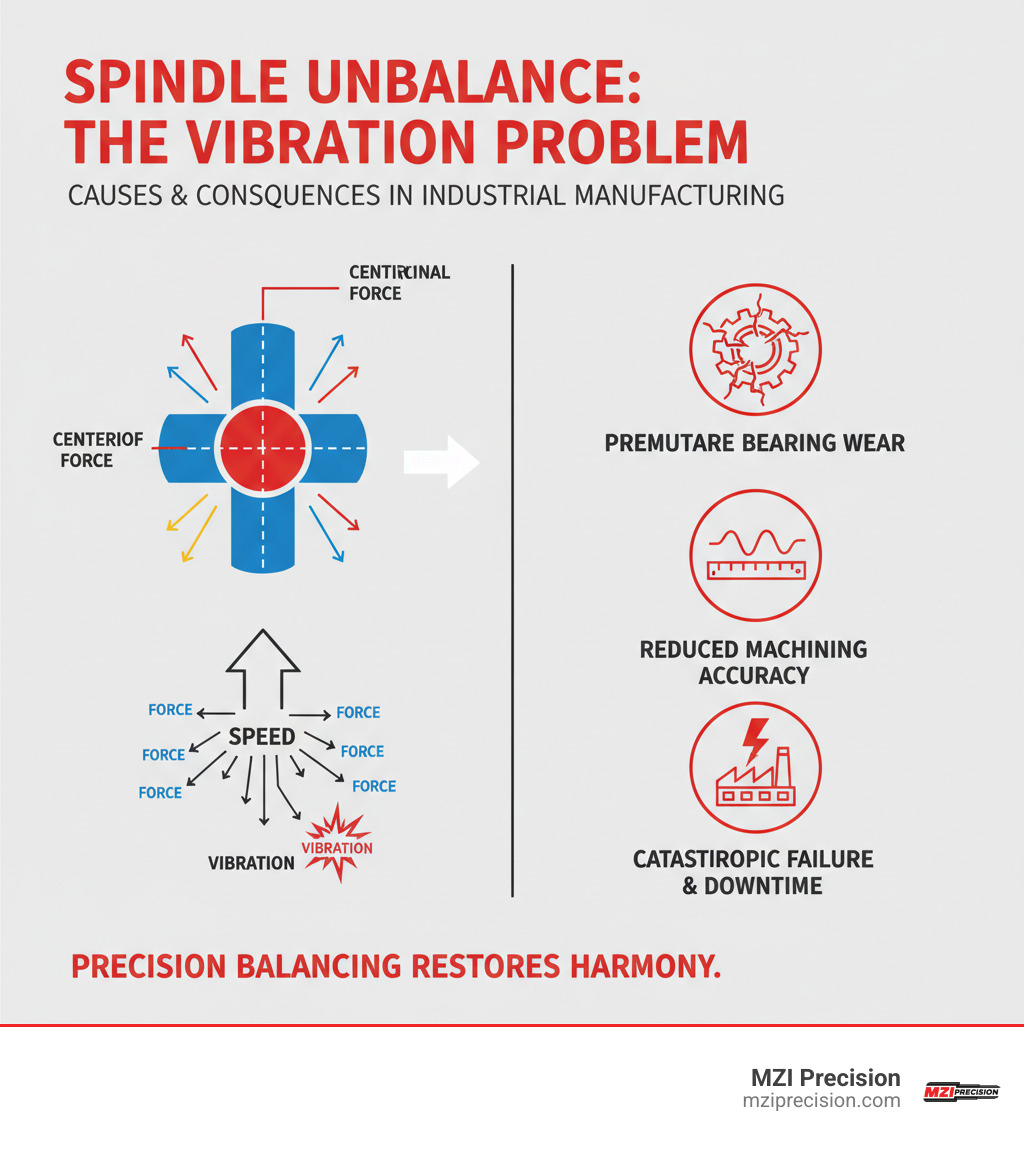
THE RIPPLE EFFECT: CAUSES AND CONSEQUENCES OF SPINDLE IMBALANCE

When the smooth hum of a perfectly balanced spindle breaks down, the consequences ripple through your entire operation. Even a tiny imbalance in an industrial manufacturing spindle escalates as speeds increase, shaking the machine tool, damaging components, and ruining precision work.
What Causes Spindles to Become Unbalanced?
Imbalance isn’t a single event but a gradual process. It can stem from microscopic manufacturing tolerances, where slight variations in material density or geometry create issues at high RPMs. Over time, operational wear and corrosion alter the spindle’s mass distribution. Thermal distortion during operation causes uneven expansion, temporarily shifting the center of mass. Finally, asymmetrical components like keyways and mounting holes, or even improper assembly, can introduce or worsen imbalance. Recognizing these sources helps you know when precision balancing services are necessary.
The Real Cost of Ignoring Imbalance
The consequences of an unbalanced spindle are significant and costly:
- Excessive vibration: The most obvious symptom, vibration transmits destructive forces through every bearing, seal, and mounting point, actively destroying your equipment.
- Premature bearing failure: Research shows over half of electric motor breakdowns stem from bearing damage caused by rotor imbalance. Replacing bearings means downtime, labor, and expensive parts.
- Reduced spindle lifespan: Vibration accelerates wear on seals, couplings, and the spindle shaft itself, forcing premature rebuilds or replacements of your expensive precision spindles.
- Poor workpiece surface finish: A vibrating tool cannot maintain consistent contact with the workpiece, resulting in chatter marks, rough surfaces, and dimensional inaccuracies that lead to rejected parts.
- Increased energy consumption: An unbalanced spindle forces the motor to work harder, fighting against vibratory forces and increasing your energy bill.
- Catastrophic failure: In the worst cases, unchecked imbalance leads to fatigue cracks and component disintegration, stopping production cold and creating potential safety hazards.
What begins as a minor vibration can impact your maintenance budget, production schedule, product quality, and energy costs. That’s why professional precision balancing services are an investment in operational stability.
THE BALANCING ACT: TECHNOLOGIES AND TECHNIQUES
Precision balancing requires the right tools and a deep understanding of rotational dynamics. For industrial manufacturing spindles, this means combining cutting-edge technology with the skills of experienced technicians.
Static vs. Dynamic Balancing
Static balancing addresses force imbalance in a single plane. Imagine a disc-shaped part; if one side is heavier, gravity pulls it down. Static balancing corrects this heavy spot so the part remains neutral in any position. This method is suitable for thin, disc-like components or those operating at low speeds.
Dynamic balancing is where precision balancing services truly shine. It addresses both force imbalance and couple imbalance, which is a twisting motion created by offset weights along the shaft. This two-plane balancing is essential for virtually all high-speed industrial manufacturing spindles, as it ensures smooth operation throughout the entire rotor, not just at a single point.
The Technology Behind the Precision
Modern balancing is an exact science thanks to sophisticated equipment.
Computerized balancing machines are the core of this work. They use powerful software to analyze vibration patterns and calculate the exact amount and location of the needed correction. At MZI Precision, our machines are annually calibrated and ISO certified with NIST traceability, ensuring every measurement meets the highest accuracy standards.
High-sensitivity vibration sensors (accelerometers) detect microscopic movements, converting them into electrical signals. Data acquisition systems process thousands of data points to isolate the imbalance signature. Technicians then apply corrections using precise material correction methods, typically by drilling or milling away tiny amounts of material from the heavy spot. This requires meticulous attention to detail to avoid creating a new imbalance.
The Standards That Define Quality
ISO 1940-1 provides a universal framework for balance quality. The standard uses G-Grades to specify the maximum permissible residual imbalance for a given rotor type and speed. Lower G-numbers mean higher precision.
A G6.3 grade might be fine for general machinery, but high-speed, high-precision applications demand G1.0 or even G0.4. The G1.0 balance grade is one of the highest precision levels, ensuring exceptionally smooth operation and minimal vibration. It’s the level of precision needed when every micron matters and performance cannot be compromised.
By combining advanced technologies with strict adherence to ISO standards, professional precision balancing services transform inefficient spindles into reliable powerhouses. To learn more, see our guide: The Balancing Game: Achieving Precision with High-Speed Spindles.
THE ROI OF STABILITY: KEY BENEFITS OF PROFESSIONAL PRECISION BALANCING SERVICES

In industrial manufacturing, every investment must pay off. Precision balancing services are not just a maintenance cost but a strategic investment that directly impacts your bottom line by improving performance across your entire operation.
-
Extended Spindle Lifespan: Proper balancing eliminates the destructive vibration that wears out bearings, seals, and the spindle shaft. This can add years to your spindle’s operational life, deferring replacement costs and improving the return on your capital investment.
-
Improved Machining Accuracy: For industries where micron-level precision is critical, a balanced spindle is essential. It prevents tool vibration, eliminating chatter marks and rough surface finishes. The result is superior part quality and fewer rejections, which is vital in sectors like aerospace manufacturing.
-
Increased Reliability and Reduced Downtime: Unbalanced spindles are unpredictable and a common source of catastrophic failure. Balancing addresses the root cause of many mechanical issues, making your equipment more reliable. This prevents unplanned downtime, which is one of the most expensive problems in manufacturing.
-
Lower Energy Costs: An unbalanced spindle forces its motor to work harder, consuming more energy. A precisely balanced spindle operates with minimal resistance, allowing the motor to run efficiently and leading to meaningful reductions in your electricity bills.
-
Quieter and Safer Operation: A balanced spindle runs remarkably quietly, reducing workplace noise that contributes to operator fatigue. More importantly, it improves safety by eliminating the risk of catastrophic component failure, protecting both personnel and equipment.
The ROI from precision balancing services is clear and long-lasting, visible in lower costs, fewer rejected parts, and longer equipment life. For more on how this applies to high-speed applications, see our guide on high-speed spindle balancing.
CHOOSING YOUR PARTNER: SELECTING THE RIGHT PROVIDER
Choosing the right provider for precision balancing services is a critical decision. You are partnering with an expert who will protect your valuable industrial manufacturing spindles and ensure they perform at their peak.
KEY QUALIFICATIONS FOR TOP-TIER PRECISION BALANCING SERVICES
Look for a provider with these essential qualifications:
- State-of-the-art equipment: Modern, computerized balancing machines are necessary to detect and correct the microscopic imbalances found in high-speed spindles.
- ISO certified processes: A provider whose machines are annually calibrated and ISO certified (with NIST traceability, like at MZI Precision) guarantees that their work meets global quality benchmarks.
- Documented quality control: You should receive comprehensive reports detailing the initial imbalance, corrections made, and the final balance quality achieved (e.g., ISO G-grade). This documentation is proof of precision.
- Expertise in precision spindles: Your provider must understand the unique designs and operational demands of different spindle types. Our experience with OEMs rebuilt spindles gives us this specialized knowledge.
- Experienced technicians: Skilled professionals are needed to interpret data and apply corrections accurately.
- Proven track record: A history of successful projects and satisfied clients in your region, such as our work throughout California, demonstrates reliability and capability.
EVALUATING THE SCOPE OF PRECISION BALANCING SERVICES
Consider the breadth of services offered:
- Comprehensive diagnostics: A thorough assessment using vibration analysis should precede any correction to accurately identify the problem.
- Integrated service: Balancing is most effective when performed as part of a complete spindle repair service or rebuild. This holistic approach ensures all potential issues are addressed.
- Detailed reporting: Transparent documentation should be standard, providing valuable data for your maintenance records.
- Warranty on work: A solid warranty on parts and labor demonstrates the provider’s confidence in their craftsmanship and protects your investment.
The best partners view balancing as a key part of an overall machinery reliability strategy. For more on this, resources like Understanding the broader reliability strategy offer valuable insights. By evaluating these factors, you can select a partner like MZI Precision to deliver the expert precision balancing services your spindles deserve.
FREQUENTLY ASKED QUESTIONS ABOUT SPINDLE BALANCING
Here are answers to the most common questions we receive about precision balancing services for industrial manufacturing spindles.
WHAT IS THE DIFFERENCE BETWEEN STATIC AND DYNAMIC BALANCING?
Static balancing corrects force imbalance in a single plane. It’s suitable for thin, disc-shaped parts like pulleys that are wide but not long. It ensures a part won’t settle with a heavy side down when at rest.
Dynamic balancing is essential for industrial manufacturing spindles. It corrects both force and couple imbalance (a twisting effect) across two separate planes. Since machine tool spindles are elongated and run at high speeds, dynamic balancing is the only method that ensures smooth operation along the entire rotor.
HOW OFTEN DOES AN INDUSTRIAL SPINDLE NEED BALANCING?
Balancing is not a routine, time-based maintenance task. Instead, it’s event-driven. The most critical time for balancing is during any spindle rebuild or major repair to correct for any changes in mass distribution. You should also consider balancing if you notice an increase in vibration levels, after a machine crash, or when replacing major rotating components. Condition-based monitoring is the best way to determine if balancing is needed between rebuilds.
WHAT ARE ISO BALANCE QUALITY GRADES (G-GRADES)?
G-grades are part of the ISO 1940-1 standard and define the acceptable level of residual imbalance for a rotor based on its mass and maximum operating speed. The key takeaway is that lower G-numbers indicate higher precision.
While a G6.3 grade might be acceptable for general-purpose machinery, high-speed industrial manufacturing spindles require much tighter tolerances. For demanding applications in aerospace and precision machining, a grade of G1.0 or even G0.4 is necessary. Achieving these grades ensures minimal vibration, extended bearing life, and superior part quality. When evaluating precision balancing services, always confirm they can achieve the G-grade your application requires.
CONCLUSION: ACHIEVE PEAK PERFORMANCE WITH EXPERT BALANCING
In industrial manufacturing, precision is paramount. As we’ve seen, even the slightest spindle imbalance can lead to premature wear, poor surface finishes, and costly unplanned downtime. The evidence is clear: professional precision balancing services are a critical investment in your operational stability and profitability.
This process protects your spindles, ensures part quality, and keeps production on schedule. It also creates a safer, quieter workplace and reduces energy consumption. However, achieving true precision requires specialized expertise, advanced equipment calibrated to exacting standards, and technicians who understand the unique demands of industrial manufacturing spindles.
At MZI Precision, we understand these stakes. Our experience with OEMs rebuilt spindles means we treat every balancing job with meticulous attention to detail. We integrate precision balancing into our comprehensive spindle repair and balancing services, ensuring your spindles achieve the highest balance quality grades (G1.0 or better) and return to your floor ready for peak performance.
Your industrial manufacturing spindles are too critical to trust to anything less than expert care. Manufacturers throughout California, from Los Angeles to Huntington Beach, trust MZI Precision to keep their equipment running smoothly and reliably.
Ready to experience the difference that true precision balancing makes? Contact us today to discuss how we can help your spindles achieve maximum longevity and performance.