

The True Cost of Spindle Downtime: Why OEM Rebuilds Matter
An OEM Spindle Rebuild is a comprehensive restoration process performed by the original equipment manufacturer or their authorized service provider that returns a worn, damaged, or failed spindle to its original factory specifications or better.
What is an OEM Spindle Rebuild?
- A complete disassembly, inspection, and restoration of an industrial spindle
- Replacement of bearings, seals, and worn components with genuine OEM parts
- Precision balancing and testing to meet or exceed original specifications
- Typically includes a warranty of 12-24 months
- Often 40-60% less expensive than purchasing a new spindle
When your manufacturing spindle stops working properly, your entire production line suffers. With machines costing upwards of $10,000 per hour in downtime, getting your spindle rebuilt correctly the first time isn’t just a maintenance decision—it’s a critical business imperative.
“Spindle damage is usually synonymous with the total failure of your machine and thus a marked decline in your production capacity,” notes one industry expert. This stark reality explains why leading manufacturers across aerospace, defense, automotive, and medical industries trust OEM rebuilding services to minimize downtime and maximize productivity.
Unlike third-party repairs that might cut corners or use aftermarket components, an OEM spindle rebuild ensures that your critical equipment returns to service with the precise tolerances and performance characteristics it was designed to have—often within tolerances as tight as 2 microns (that’s thinner than a human hair).
The most reputable OEM spindle rebuild providers, like MZI Precision with decades of experience, employ teams of specialized engineers who understand the intricate details of your specific spindle model. This expertise allows them to not only repair what’s broken but also identify and address underlying issues that might cause premature failure in the future.

What Is an OEM Spindle Rebuild?
When we talk about an OEM Spindle Rebuild, we’re referring to a comprehensive restoration process that brings your industrial manufacturing spindle back to its original factory specifications—or in many cases, even better than new. This isn’t just a quick fix or band-aid solution; it’s a complete renewal of a critical manufacturing component that keeps your production line running smoothly.
OEM Spindle Rebuild Definition & Scope
An OEM Spindle Rebuild involves the complete disassembly, inspection, cleaning, and restoration of a spindle by technicians who have access to the original factory specifications, drawings, and components. Think of it as giving your spindle a new lease on life.
This meticulous process applies to all types of industrial spindles you might have on your shop floor. Whether you’re running belt-driven workhorses, sophisticated motorized spindles with internal motors, direct-drive precision units, gear-driven powerhouses, or high-speed spindles capable of reaching mind-boggling speeds up to 150,000 RPM – we handle them all with the same attention to detail.
At MZI Precision, we understand that each spindle type has its own personality and quirks. Our technicians work with the actual factory prints and specifications to ensure every rebuild meets or exceeds what the original engineers intended.
“When we rebuild a spindle to OEM specifications, we’re not just fixing what’s broken,” explains one of our senior technicians. “We’re restoring the entire assembly to like-new condition, ensuring it will deliver the same precision, power, and reliability as when it first arrived at your facility.”
The scope of our OEM rebuilds is comprehensive – we disassemble the entire unit, inspect every component with a meticulous eye, measure critical dimensions down to the micron, replace all bearings, seals, and worn components, restore bearing journals and mounting surfaces to pristine condition, precisely balance all rotating assemblies, reassemble everything to factory specs, and then put the unit through rigorous testing. Nothing leaves our facility until we’re confident it will perform flawlessly in yours.
OEM Spindle Rebuild vs Third-Party Repair
It’s important to understand the difference between a true OEM Spindle Rebuild and a third-party repair. The distinction isn’t just marketing talk – it directly impacts your production quality, reliability, and ultimately, your bottom line.
| Aspect | OEM Spindle Rebuild | Third-Party Repair |
|---|---|---|
| Specifications | Uses original factory drawings and tolerances | May use reverse-engineered specs |
| Parts | Genuine OEM components or better | Often aftermarket components |
| Engineering Support | Access to original design engineers | Limited engineering resources |
| Process | Comprehensive rebuild to factory standards | Often focused only on failed components |
| Testing | Rigorous testing to OEM specifications | Variable testing standards |
| Warranty | Typically 12-24 months | Often 6-12 months |
| Documentation | Complete documentation package | Limited documentation |
| Liability | Full manufacturer backing | Limited liability coverage |
One critical advantage we offer at MZI Precision is access to original engineering drawings and specifications. We’ve built strong relationships with major OEMs and have the exact tolerances and specifications your spindle requires. Third-party shops often have to make educated guesses through reverse-engineering, which can lead to inconsistent performance.
“When we’re working with a customer’s spindle, we’re not playing a guessing game about what the tolerances should be,” says our head engineer with a smile. “We know exactly what the manufacturer intended, which means we can deliver a spindle that performs exactly as it should – sometimes even better.”
The science behind tool spindles is complex, involving precision engineering down to the micron level. As noted in scientific research on tool spindles), these components must maintain incredible precision while operating under extreme conditions. When you choose an OEM rebuild, you’re choosing to restore your equipment to the exact specifications the engineers originally designed.
Step-by-Step OEM Spindle Rebuild Process
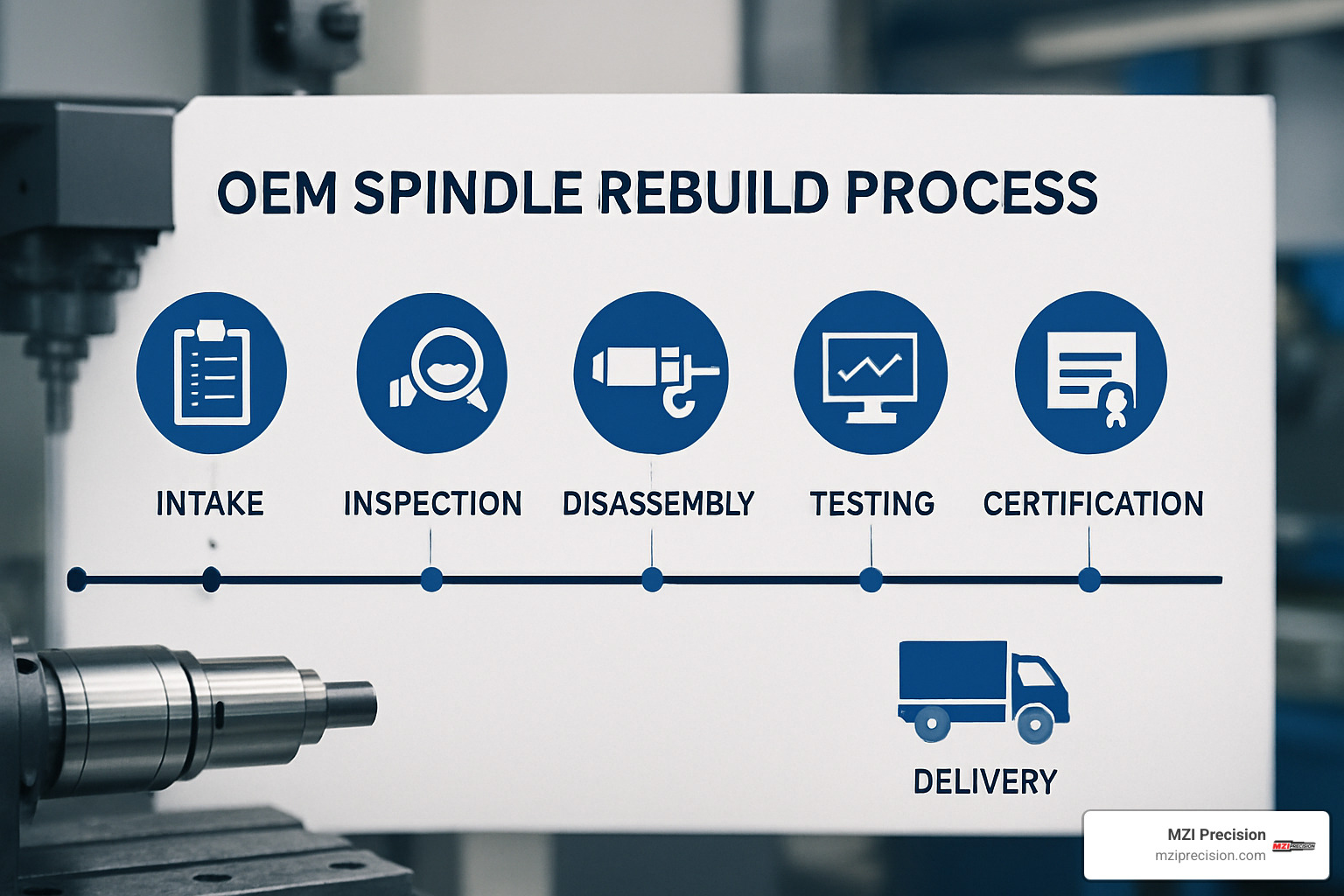
When you send your spindle to MZI Precision for an OEM Spindle Rebuild, you’re not just getting a quick fix—you’re investing in a comprehensive restoration that brings your equipment back to peak performance. Let’s pull back the curtain and show you exactly what happens during this meticulous process.
OEM Spindle Rebuild Inspection & Failure Analysis
Every successful rebuild starts with understanding what went wrong. Think of this stage as detective work—we’re solving the mystery of your spindle failure to prevent it from happening again.
When your spindle arrives at our facility, our technicians carefully document its condition with photographs and notes. This gives us a baseline to work from and helps with warranty documentation. Next comes the careful disassembly in our clean room environment, where every component is handled with precision.
“We don’t just want to fix what’s broken,” explains our lead technician. “We need to understand why it broke in the first place. Otherwise, you might find yourself sending the same spindle back in a few months.”
After thorough ultrasonic cleaning to remove all contaminants, we bring out our advanced metrology equipment. This is where the micron-level precision comes into play—we’re talking measurements so fine they’re smaller than a human hair. These readings tell us exactly how components have worn or become damaged, and we compare everything against the original OEM specifications.
The failure analysis is perhaps the most valuable part of this stage. Was it normal bearing fatigue? Contamination from improper sealing? A crash event? Understanding the root cause helps us not only rebuild your spindle correctly but also provide recommendations that might extend its service life in the future.
Component Replacement & Re-Engineering
With a clear understanding of what needs attention, we move into the restoration phase of your OEM Spindle Rebuild. This is where craftsmanship meets engineering precision.
Bearing replacement is non-negotiable—we always install new super-precision bearings that meet or exceed original specifications. Even bearings that look fine can harbor microscopic damage that could lead to premature failure, so we never take chances with your productivity.
For the spindle shaft—the heart of the assembly—we employ specialized restoration techniques when needed. Hard chrome plating, precision grinding, and meticulous polishing bring critical surfaces back to their original dimensions, often with tolerances measured in microns.
The housing that supports everything receives equal attention. Bearing seats must be perfectly sized and aligned for proper operation, so we carefully recondition these surfaces to ensure ideal fits. For machining center spindles, we completely rebuild the drawbar system with new springs and seals to restore proper tool clamping force—a critical factor in machining accuracy and tool life.
“Sometimes the challenge isn’t just fixing what’s worn—it’s sourcing parts that might no longer be manufactured,” notes our engineering manager. “That’s where our reverse engineering capabilities come into play.”
For older spindles where original components may be obsolete, our engineering team can recreate the necessary parts to OEM specifications. We carefully manufacture precision spacers to ensure proper bearing preload, and replace every seal and O-ring to prevent future contamination issues.
Final Validation: Meet or Exceed OEM Specs
The true measure of an OEM Spindle Rebuild isn’t just in the parts replaced—it’s in the performance delivered. Our validation process ensures your spindle doesn’t just look new; it performs like new or better.
Once reassembly is complete in our clean room environment, we begin a carefully controlled run-in process. This allows bearings to properly seat and lubrication to distribute evenly throughout the assembly. For high-speed spindles, we perform dynamic balancing to tolerances of 0.1 mil or better, eliminating vibration that could affect machining quality or spindle life.
Precision testing continues with runout measurements, typically verified to within 2 microns—essential for accurate machining results. Throughout extended testing cycles, we monitor bearing temperatures to ensure they remain within acceptable limits under load, and perform sophisticated vibration analysis across the spindle’s entire speed range.
For tool-holding spindles, we verify the drawbar system delivers consistent and correct clamping force through pull-force testing. This ensures your tools will be held securely during operation, preventing costly and dangerous tool pullout issues.
“The testing phase isn’t just a box to check—it’s our promise to you,” says our quality control manager. “When a spindle leaves our facility, we’re confident it will perform exactly as designed in your machine.”
Every OEM Spindle Rebuild is completed with comprehensive documentation of all test results. This documentation package travels with your spindle back to your facility, giving you confidence that it’s ready to perform and providing valuable baseline data for future maintenance planning.
Why Choose OEM Over Third-Party Repairs?
When your manufacturing line grinds to a halt because of a spindle issue, you need a solution that gets you back up and running quickly—without sacrificing quality. This is where an OEM Spindle Rebuild truly shines compared to quick-fix third-party repairs.
At MZI Precision, we’ve seen countless customers come to us after a third-party repair failed prematurely. The story is often the same: they chose the quickest or cheapest option, only to face more downtime and higher costs in the long run.
“I learned the hard way that not all spindle rebuilds are created equal,” one of our manufacturing clients told us. “After three failed attempts with a local repair shop, we switched to an OEM rebuild. That was four years ago, and that spindle is still running perfectly.”
OEM Spindle Rebuild Warranty & Guarantees
One of the most compelling reasons to choose an OEM Spindle Rebuild is the peace of mind that comes with comprehensive warranty coverage. When we rebuild your spindle at MZI Precision, we’re not just fixing it—we’re standing behind our work with confidence.
Our 24-month warranty on most rebuilt spindles speaks volumes about our quality standards. Compare this to the typical 6-12 month coverage from third-party shops, and you’ll understand why manufacturers who can’t afford downtime choose OEM rebuilds.
But our commitment goes beyond just the warranty period. Each rebuilt spindle comes with a detailed documentation package showing exactly what work was performed, complete with before-and-after measurements. You’ll receive a certificate of conformance confirming your spindle meets or exceeds all original specifications—something third-party shops rarely provide.
“We don’t just want your spindle to work when we ship it back,” explains our service manager with a smile. “We want it to work flawlessly for years to come. That’s why we test, document, and certify everything we do.”
OEM Spindle Rebuild vs New Replacement
When faced with a failed spindle, many manufacturers wonder: repair, rebuild, or replace? The numbers tell a compelling story in favor of an OEM Spindle Rebuild.
| Factor | OEM Spindle Rebuild | New Replacement Spindle |
|---|---|---|
| Cost | 40-60% of new price | 100% of new price |
| Lead Time | Typically 3-10 days | Often 4-12 weeks |
| Performance | Equal to or better than new | Factory standard |
| Warranty | 12-24 months | 12 months typical |
| Sustainability | Reuses existing components | Requires all new materials |
| Customization | Can include performance upgrades | Standard configuration |
The cost savings alone are substantial—typically 40-60% compared to buying new. But the real value comes from dramatically reduced downtime. While a new spindle might take 4-12 weeks to arrive, we can typically complete an OEM Spindle Rebuild in just 3-10 days.
There’s also an environmental benefit worth considering. By reusing the spindle housing and other components that don’t require replacement, you’re making a more sustainable choice that reduces waste and resource consumption.
Perhaps most importantly, an OEM rebuild often results in a spindle that performs better than new. Why? Because we can incorporate the latest bearing technologies and sealing methods—even for spindles that have been in service for many years.
“One of our aerospace customers had a 15-year-old machine with a failed spindle,” recalls our lead technician. “After our rebuild, they called to say the surface finishes they were achieving were better than when the machine was brand new. That’s the power of combining original specifications with modern components.”
When production quality, reliability, and minimizing future downtime are priorities—and they should be—an OEM Spindle Rebuild from MZI Precision is the clear choice for discerning manufacturers.
Costs, Turnaround & Warranty Demystified
Let’s pull back the curtain on what you can really expect when investing in an OEM Spindle Rebuild. Understanding the costs, timeframes, and warranty coverage helps you make smarter decisions about your critical equipment.
Budgeting for an OEM Spindle Rebuild
“How much will this cost me?” It’s probably the first question on your mind, and understandably so. The truth is that spindle rebuild costs vary widely based on several key factors.
Your high-speed motorized spindles will typically cost more to rebuild than simpler belt-driven models. Why? They’re more complex beasts with tighter tolerances and more sophisticated components. A spindle that’s suffered a dramatic crash will naturally require more extensive repairs than one that’s simply worn out over time.
The bearing class selection makes a significant difference too. While standard bearings might seem like a cost-saving choice, investing in ABEC 7 or ABEC 9 super-precision bearings often pays dividends through extended spindle life and better performance. Yes, they cost more upfront, but they’re frequently worth every penny in the long run.
“We often see customers try to save money on bearings, only to have their spindle fail prematurely,” shares our lead technician. “It’s like putting economy tires on a race car – you’re undermining the potential of your equipment.”
At MZI Precision, we believe in transparent pricing with no surprises. After our initial inspection, we’ll provide a detailed quote explaining exactly what work is needed and why. We want you to understand the value you’re receiving, not just the price you’re paying.
Most standard rebuilds have a typical turnaround of 3-10 days, though expedited service is available when your production simply can’t wait. Our team works diligently to minimize your downtime while never compromising on quality.
Hidden Value: Documentation & Ongoing Support
The real value of an OEM Spindle Rebuild extends far beyond just fixing what’s broken. When your spindle returns from MZI Precision, it comes with a comprehensive documentation package that serves as both proof of quality and a valuable reference for your maintenance team.
This package includes detailed test charts showing vibration levels, temperature performance, and other key metrics measured during our rigorous testing process. These aren’t just numbers on a page – they’re benchmarks you can use to monitor your spindle’s health over time.
Based on what we find during your rebuild, we’ll provide custom maintenance recommendations to help extend your spindle’s service life. This might include specific lubrication schedules, operational guidelines, or environmental considerations unique to your application.
“I remember a customer who was burning through spindles every six months,” recalls our service manager. “After we rebuilt their spindle and identified that their coolant mixture was causing premature seal failure, they implemented our recommendations and haven’t had a failure in over two years. That’s the kind of long-term value we deliver.”
Our support doesn’t end when your spindle ships. Our technical team remains available to answer questions and provide guidance as long as your spindle is in service. This ongoing partnership ensures you get maximum value from your investment.
Perhaps most importantly, we conduct a thorough root cause analysis to help you understand what triggered the failure in the first place. Understanding whether your spindle failed due to contamination, improper tool loading, or simply reached its expected service life helps you take preventative steps for all your equipment.
When you choose an OEM Spindle Rebuild from MZI Precision, you’re not just buying a repaired component – you’re investing in knowledge, support, and confidence that your production can keep running smoothly.
Diagnosing Spindle Trouble: Causes & Warning Signs
Ever notice how your car makes that little noise right before something goes wrong? Industrial spindles are similar—they’ll try to tell you when they’re in trouble, if you know how to listen. Catching these early warning signs can be the difference between a planned OEM Spindle Rebuild and a catastrophic failure that brings your entire production line to a screeching halt.
Common Failure Triggers in Industrial Spindles
Think of your spindle like an elite athlete—even with perfect training, time eventually takes its toll. But certain conditions can dramatically shorten a spindle’s productive life.
Bearing fatigue is inevitable—even the highest quality bearings have a finite lifespan. It’s like the tires on your car; they’ll wear out eventually no matter what. But just as driving on rough roads wears tires faster, contamination from metal chips, dirt, or coolant infiltration can rapidly accelerate bearing deterioration.
“I’ve seen perfectly good spindles destroyed in weeks because of inadequate seal maintenance,” shares our lead technician. “What should have been a routine bearing replacement turned into a complete shaft replacement—tripling the rebuild cost.”
Machine crashes represent the equivalent of a car accident for your spindle. That sudden, violent stop when a tool collides with a fixture or workpiece can instantly damage bearings, bend shafts, and crack housings. Unfortunately, these dramatic events often require immediate attention and a comprehensive OEM Spindle Rebuild.
Lubrication issues work both ways—too little is obviously problematic, but many operators don’t realize that over-lubrication can be just as damaging. Excess grease creates heat and pressure that can actually push out seals and damage bearings.
For motorized spindles, electrical problems like winding shorts or insulation breakdown introduce another failure point. And don’t overlook tool holder issues—worn pull studs or contaminated tapers create uneven loading that can quickly damage precision components.
Coolant ingress might be the most insidious culprit of all. That liquid designed to cool your cutting process becomes your spindle’s worst enemy when it breaches the seals. It washes away crucial lubrication and promotes corrosion that can silently destroy internal components.
Early Warning Signs You Need an OEM Spindle Rebuild
Your spindle will almost always give you warning signs before it fails completely. Learning to recognize these signals can save thousands in emergency repair costs and lost production time.
Unusual noise is typically your first clue. That high-pitched whine or subtle grinding sound isn’t just annoying—it’s your spindle crying for help. Modern manufacturing floors are noisy places, but operators who know their machines can often detect these changes before automated systems.
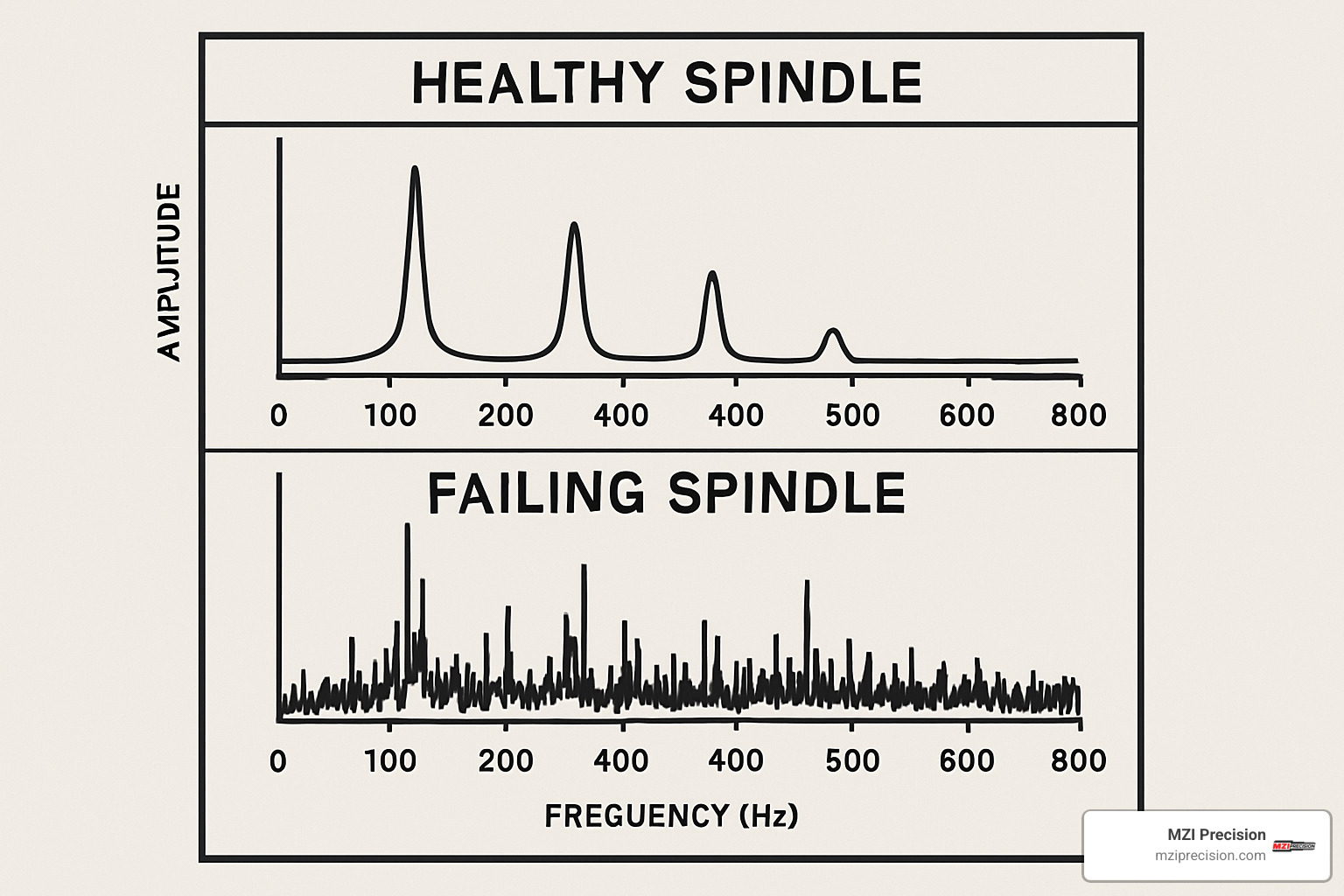
Increased vibration manifests in multiple ways. You might feel it when touching the machine (carefully and safely, of course), but it also shows up as poor surface finishes on your parts. Those tiny waves or chatter marks on otherwise smooth surfaces are telling you something’s wrong.
“By the time most people call us about vibration, their spindle bearings are already severely damaged,” our diagnostic specialist explains. “If they’d reached out when they first noticed slightly rougher surface finishes, we could have saved them thousands.”
Temperature increases around the spindle housing indicate friction where there shouldn’t be. Modern bearings should run relatively cool—excessive heat is a clear warning sign of impending failure.
Reduced accuracy in your machined parts might initially seem like a programming or tooling issue, but inconsistent dimensions often point back to spindle problems. Similarly, if your tool life has suddenly decreased, don’t just blame the tool supplier—your spindle might be developing runout issues.
Loss of drawbar force presents a particularly dangerous situation. When tools start pulling out during cuts or won’t seat properly, your drawbar system needs immediate attention before a flying tool creates a safety hazard.
At MZI Precision, we’ve developed vibration analysis services specifically designed to detect these problems before they become catastrophic. Our approach allows you to schedule your OEM Spindle Rebuild during planned maintenance windows rather than rushing a spindle to us after a complete breakdown.
“Don’t wait until you see smoke,” warns our senior rebuild technician. “By then, you’re looking at a much more extensive—and expensive—rebuild process.”
How to Start Your Own OEM Spindle Rebuild
Getting your spindle rebuilt doesn’t have to be complicated. At MZI Precision, we’ve streamlined the process to get your critical equipment back up and running with minimal hassle. Here’s how to get started with your OEM Spindle Rebuild journey.
OEM Spindle Rebuild Request Checklist
Before reaching out to us, gathering some key information will help us serve you better and get your rebuild process moving quickly.
“The first conversation is so important,” says our intake specialist. “When customers come prepared with their machine details and a good description of what’s happening, we can hit the ground running and often save them days in the diagnostic process.”
To ensure a smooth start, have these details ready:
Your machine information is crucial—we’ll need the make, model, and serial number of the equipment the spindle came from. This helps us access the correct specifications and identify any known issues with that particular configuration.
Equally important are your spindle details—the model, serial number, and any identifying marks or labels you can see. These act like a fingerprint for your specific component.
Be ready to share a detailed failure description. Did it make unusual noises before failing? Was there excessive heat? Did you notice vibration or poor surface finishes on your parts? These symptoms are valuable clues for our technicians.
Your spindle’s operating history provides essential context. Tell us about typical speeds, materials being machined, coolant types, and any recent maintenance or changes to operating parameters. Sometimes the smallest detail can reveal the root cause of a problem.
Don’t forget to include reliable contact information for your technical person who understands the equipment and can answer follow-up questions if needed.
Finally, let us know your return requirements—when do you need the spindle back? Is this an emergency situation that requires expedited service?
Logistics: From Plant Floor to OEM Service Lab
Safely transporting your spindle to our facility is critical to the success of your OEM Spindle Rebuild. Proper handling prevents additional damage that could complicate the rebuild process.
“I’ve seen spindles arrive in everything from custom-built crates to wrapped in bubble wrap and stuffed in a cardboard box,” shares our receiving manager with a smile. “Trust me—the ones in proper packaging always fare better during transit.”
Start with proper removal from your machine. If you’re unsure about safe removal techniques, just call us—we’re happy to provide guidance to prevent additional damage during this critical step.
Once removed, protect all precision surfaces with appropriate materials. Cover exposed areas with clean, lint-free materials and cap or plug any openings to keep contaminants out. Think of your spindle as a precision instrument (because it is!), and protect it accordingly.
For shipping, use secure packaging that prevents movement during transit. A sturdy crate with proper cushioning material is ideal. The spindle should be completely immobilized—if it can shift during shipping, it can sustain damage.
Don’t forget to arrange for adequate insurance on your shipment. Industrial spindles are valuable components, and proper coverage protects your investment if something goes wrong during transit.
Include a completed copy of our Spindle Repair Request Form with all the details we discussed earlier. This ensures your information stays with the spindle throughout the process.
Once your spindle arrives at MZI Precision, our team springs into action. We’ll perform an initial inspection and contact you with our findings and recommendations, typically within 24-48 hours. After your approval, we’ll proceed with the rebuild according to the timeline we’ve agreed upon.
“We understand that every day your spindle is down costs you money,” our operations manager emphasizes. “That’s why we’ve designed our intake process to be as efficient as possible—so we can get your equipment back to you quickly, performing better than ever.”
Ready to start your OEM Spindle Rebuild? Contact our team today, and we’ll guide you through each step of the process with the care and expertise your valuable equipment deserves.
Frequently Asked Questions about OEM Spindle Rebuild
How long will the rebuild take?
When your production line is down, every hour counts. At MZI Precision, we understand this pressure and have streamlined our OEM Spindle Rebuild process to get you back up and running quickly.
Most standard rebuilds are completed within 3-10 business days after you approve our quote. Need it faster? Our expedited service can turn around certain spindle types in just 1-3 days. And for those truly critical situations where production losses are mounting by the hour, we offer emergency same-day or next-day service for qualifying cases.
“We’ve structured our entire workflow around minimizing your downtime,” explains our operations manager with a smile. “Our technicians know that every day your machine sits idle is costing you real money.”
After we complete our initial inspection, you’ll receive a specific timeline estimate that you can count on. We’ll also keep you updated throughout the process, so you’re never left wondering about your spindle’s status.
Will my spindle be upgraded or just repaired?
When we perform an OEM Spindle Rebuild, we’re not just fixing what broke—we’re taking the opportunity to make your spindle better than it was before.
At minimum, every rebuild includes replacement of all bearings, seals, and worn components with new parts that meet or exceed original specifications. But that’s just the starting point. Where appropriate, we can incorporate performance upgrades like higher-grade bearings, improved sealing systems, or improved lubrication methods that weren’t available when your spindle was originally manufactured.
If your spindle’s original design had known weaknesses (and many do), we can implement engineering improvements while maintaining perfect compatibility with your machine. For customers with unique requirements, we can even customize aspects like speed capability or coolant delivery to better match your specific application.
“We approach each rebuild as an opportunity for improvement,” our engineering manager explains. “Why just restore something to its original state when we can make it perform even better?”
During our initial inspection, we’ll identify potential upgrades specific to your spindle and discuss these options with you before proceeding. This consultative approach ensures you get exactly what your operation needs.
What documentation do I receive?
Documentation might not be the most exciting part of an OEM Spindle Rebuild, but it’s incredibly valuable for your maintenance team and future troubleshooting.
When your freshly rebuilt spindle arrives back at your facility, it comes with a comprehensive documentation package that includes:
A detailed inspection report that identifies what caused the failure in the first place, helping you prevent recurrence. You’ll receive a complete list of all work performed and components replaced, along with thorough test results documenting runout measurements, vibration analysis, and temperature monitoring during testing.
We also include a formal Certificate of Conformance confirming your spindle meets or exceeds all applicable OEM specifications, plus clear warranty information outlining your coverage period and terms.
Perhaps most valuable are the maintenance recommendations and return-to-service guidelines that help your team properly install and break in the spindle while avoiding common mistakes that could shorten its lifespan.
“This documentation isn’t just paperwork we include to look professional,” notes our quality manager. “It’s your spindle’s backstory and instruction manual combined into one package. Many of our customers keep these records for the life of their machine and refer to them regularly.”
The detailed documentation also proves invaluable during future maintenance cycles, giving your team insights into the spindle’s history and performance benchmarks to compare against.
Conclusion
When your manufacturing line grinds to a halt because of spindle issues, every minute counts. That’s why an OEM Spindle Rebuild isn’t just a maintenance decision—it’s a strategic investment in your operation’s future.
At MZI Precision, we’ve seen how properly rebuilt spindles breathe new life into production equipment. Our customers often tell us they’re surprised to find their machines performing even better than before the failure occurred.
“My machine is actually holding tighter tolerances now than when it was new,” one aerospace customer recently shared after we completed their OEM Spindle Rebuild. That’s the kind of result we aim for with every rebuild we perform.
When you choose an OEM Spindle Rebuild from our team, your equipment returns to service with:
Precision that meets or exceeds original factory specifications, often achieving runout measurements of 2 microns or less. This translates directly to better part quality and reduced scrap rates.
Reliability built on genuine OEM-quality components and assembly techniques that follow exact factory procedures. Our rebuilds are designed to deliver years of trouble-free operation.
Performance that’s validated through rigorous testing—we don’t just rebuild your spindle, we prove it works exactly as intended before it leaves our facility.
Warranty protection that gives you peace of mind, with coverage periods that often exceed what was offered when the spindle was new.
Comprehensive documentation that provides valuable insights for your maintenance team and creates a historical record for future reference.
Exceptional value by delivering like-new performance at typically 40-60% of replacement cost, while also reducing the environmental impact of manufacturing new components.
Our dedicated team brings decades of specialized experience to every project. Whether you’re running critical aerospace components or high-volume automotive production, we understand that your spindle isn’t just a part—it’s the heart of your manufacturing process.
“We treat every spindle as if our own production line depends on it,” explains our lead technician. “Because for our customers, that’s exactly what’s at stake.”
Ready to get your production back on track? Contact MZI Precision today to discuss your OEM Spindle Rebuild needs. Our experts will guide you through the process and help you minimize downtime while maximizing productivity.
For more information about specific spindle types or to learn about our services for particular machine brands such as Doosan, visit our OEMs rebuilt page or speak with one of our experts today. We’re here to keep your production running at peak performance.