

130mm spindle servo motor: Ultimate Guide 2025
Why Choosing the Right Spindle Servo Motor Size Matters for Your Manufacturing Operations
130mm spindle servo motors are precision-engineered components that deliver reliable power and control in industrial manufacturing applications. Here’s what you need to know:
Key Specifications:
- Power Range: 1kW to 2.6kW typical output
- Torque Output: 4Nm to 10Nm rated torque
- Speed: 1000-2500 RPM rated speeds
- Voltage: 220V standard, 380V available
- Frame Size: 130mm flange diameter
- Applications: CNC milling, grinding, automated production
When you’re selecting a spindle servo motor for your manufacturing equipment, size matters more than you might think. The difference between a 130mm and 150mm frame can impact everything from your machine’s cutting performance to its overall footprint on your shop floor.
A 130mm spindle servo motor typically delivers between 1kW and 2.6kW of power with torque ratings from 4Nm to 10Nm. These motors excel in applications requiring precise positioning and consistent performance – exactly what aerospace manufacturers need for their critical machining operations.
The choice between motor sizes isn’t just about power output. It’s about matching your specific application requirements with the right balance of performance, space constraints, and installation flexibility.
Whether you’re retrofitting existing equipment or designing new manufacturing systems, understanding these differences helps you make informed decisions that impact your production efficiency and long-term maintenance costs.
Understanding the Core Specifications of a 130mm Spindle Servo Motor
When we talk about a 130mm spindle servo motor, we’re referring to its flange size – that crucial dimension that determines how it mounts into your machinery. But there’s so much more to these industrial workhorses than just their physical footprint. Think of understanding their specifications as getting to know a new team member – you want to know what they’re capable of and how they’ll fit into your operation.
Performance Characteristics of a 130mm Spindle Servo Motor
Let’s explore what makes these motors tick. The heart of any 130mm spindle servo motor lies in its performance trio: power, torque, and speed. These aren’t just numbers on a spec sheet – they tell the story of what your motor can actually accomplish on your shop floor.
Power ratings for these motors typically range from 1kW to 2.6kW. That 1kW motor might seem modest, but it’s often perfect for precision work where finesse matters more than brute force. The 2.6kW models, on the other hand, bring serious muscle to demanding applications.
Torque output is where things get interesting. We see rated torque ranging from 4Nm up to 10Nm, with some models offering peak torque that can hit 20Nm when you need that extra push. Think of torque as your motor’s ability to handle tough jobs – higher torque means it won’t bog down when cutting through challenging materials.
Rated speeds commonly fall between 1000 RPM and 2500 RPM. The slower speeds typically pair with higher torque for heavy-duty applications, while the faster speeds excel in precision machining where smooth, rapid movements are essential. The motor inertia, usually ranging from 0.85×10^-3 to 1.94×10^-3 Kg.m², affects how quickly your motor can start, stop, and change direction – crucial for those rapid positioning moves.
Encoder and Feedback Systems for Precision Control
Here’s where servo motors really shine compared to their simpler cousins. The secret sauce is in their feedback systems – sophisticated encoders that constantly keep tabs on exactly where the motor is and how fast it’s spinning.
You’ll encounter two main encoder types in the field. Incremental encoders with 2500 PPR (pulses per revolution) provide excellent control for most applications. They’re like having a very precise speedometer that also tells you direction.
Absolute encoders take things up a notch. With 17-bit resolution, these smart devices remember exactly where they are, even after power goes out. No more time-consuming homing routines when you fire up your machine on Monday morning – the system instantly knows its position.
This closed-loop control creates a constant conversation between your motor and drive system. The encoder reports “here’s where I am,” the drive compares it to “here’s where you should be,” and makes instant corrections. It’s this feedback loop that delivers the precision accuracy that makes servo motors indispensable in industrial manufacturing.
Power Supply and Installation Requirements
Getting your 130mm spindle servo motor properly powered and mounted requires attention to some key details. Most of these motors run on standard industrial power – typically 220V or 380V with 3-phase power delivery for smooth, consistent operation.
The physical installation revolves around that 130mm flange diameter, but you’ll also need to account for the motor’s overall length, shaft diameter, and mounting hole patterns. Motors can range from compact 234mm lengths for 1kW units up to 318mm for higher-power models.
Motor winding connections follow standard industrial practices, but always double-check the manufacturer’s wiring diagrams. Getting this right the first time saves headaches down the road.
Environmental protection is where the IP65 rating comes into play. This means your motor can handle the dust, coolant splashes, and general messiness of a working shop floor. Operating temperatures typically range from -20°C to +50°C, with humidity tolerance below 90% RH (non-condensing) – pretty robust for most manufacturing environments.
For detailed installation dimensions and mounting specifications, detailed motor dimension tables provide the precise measurements you need for proper fitment.
Key Applications and Advantages in Industrial Automation
The 130mm spindle servo motor has become a cornerstone of modern industrial manufacturing, and once you understand where these motors excel, you’ll see why they’re such a popular choice. Their sweet spot of power, precision, and compact design makes them perfect for applications where accuracy matters as much as performance.
Common Applications for a 130mm Spindle Servo Motor
Walk into any modern manufacturing facility, and you’ll likely hear the precise hum of 130mm spindle servo motors hard at work. These motors have found their home in some of the most demanding industrial applications.
CNC milling and grinding operations represent the bread and butter of these motors. When you’re machining complex metal parts that need tight tolerances, the precise rotational control of a 130mm spindle servo motor becomes invaluable. They handle high-speed cutting with ease while maintaining the accuracy needed for aerospace components and precision tooling.
Automated production lines rely heavily on these motors for their consistency. Whether it’s feeding materials, operating packaging equipment, or controlling textile machinery, the repeatable movements and synchronized operation these motors provide keep production running smoothly. The predictable performance means less downtime and fewer quality issues.
In robotics applications, the precision positioning capabilities shine through. When a robotic arm needs to place a component within thousandths of an inch or perform delicate assembly work, the closed-loop control of these servo motors ensures the job gets done right every time.
Laser processing equipment benefits tremendously from the smooth, accurate motion control. Whether you’re cutting, engraving, or welding, the fine control these motors provide translates directly into better edge quality and more precise results.
The common thread across all these applications? They all demand precision, reliability, and the ability to perform consistently under varying load conditions – exactly what a 130mm spindle servo motor delivers.
The Advantages of AC Servo Technology
What makes AC servo technology so compelling compared to other motor options? The answer lies in several key advantages that directly impact your manufacturing operations.
Precise position control sets these motors apart from the competition. Unlike stepper motors that can lose steps under heavy loads, AC servo motors continuously monitor and correct their position through closed-loop feedback. This means virtually no positioning errors and consistently accurate results – something that translates directly into less scrap and higher quality parts.
The high efficiency of these motors might not seem exciting, but it adds up quickly on your bottom line. They convert more electrical energy into useful mechanical work, which means lower operating costs and less heat generation. Your facility stays cooler, and your energy bills stay manageable.
High torque at low speeds gives these motors a significant edge in many manufacturing applications. When you need strong cutting forces at precise speeds, or when starting heavy loads from a standstill, this characteristic becomes crucial. Traditional induction motors struggle at low speeds, while servo motors deliver consistent torque across their entire speed range.
The dynamic response of AC servo systems means they can accelerate and decelerate rapidly while maintaining precise control. This quick response time is essential for high-speed machining operations where every millisecond counts for productivity.
Reliability and longevity might be the most important advantage of all. These motors are built for continuous operation in demanding industrial environments. Their robust construction and efficient operation mean less downtime for maintenance and longer periods between rebuilds – though when that time comes, professional spindle rebuilding services can restore them to like-new performance.
The smooth operation these motors provide isn’t just about noise levels (though they are quieter). The advanced control algorithms eliminate vibrations that can affect surface finish quality and tool life, resulting in better parts and lower tooling costs.
When you’re investing in manufacturing equipment, the superior blend of precision, power, and control that AC servo technology provides often makes the difference between meeting tight production schedules and falling behind.
The Crucial Role of the Servo Drive and Control System
Think of your 130mm spindle servo motor as a talented musician – it has all the potential in the world, but without a skilled conductor, it’s just noise. That’s exactly what the servo drive and control system do for your motor. They’re the behind-the-scenes heroes that transform raw electrical power into the precise, coordinated movements your manufacturing processes depend on.
Essential Servo Drive Features and Functions
The servo drive – sometimes called a servo amplifier – is essentially your motor’s personal translator. It takes the high-level commands from your CNC controller or PLC and converts them into the precise electrical signals that make your 130mm spindle servo motor dance to your tune.
Modern servo drives are remarkably versatile, offering multiple control modes to match whatever your application throws at them. When you need exact positioning for tool changes or robotic movements, position control mode steps up. For maintaining that perfect RPM during cutting operations, speed control keeps everything spinning smoothly. And when you need consistent force regardless of speed, torque control delivers exactly what you’re looking for. Many drives also include inner speed and JOG control modes, which are lifesavers during setup and manual operations.
The response frequency of your drive tells you how quickly it can react to changes – and in precision manufacturing, every millisecond counts. We’re talking about frequencies of 400Hz or higher in quality drives, which translates directly to faster, more accurate control and better surface finishes on your parts.
For integration into larger industrial networks, modern drives support standard communication protocols like RS484 Modbus. This isn’t just tech speak – it means your drive can talk to other equipment, share data, and be controlled remotely, making complex automation setups much simpler.
The programmability features are where things get really interesting. Many drives let you set up programmable speed ranges, soft start and stop functions, and even reverse on the fly capabilities. This flexibility can reduce wear on mechanical components and give you options you didn’t know you needed.
Built-in Protection for Spindle Longevity
Industrial manufacturing environments don’t mess around, and neither should your motor protection. The continuous operation demands of high-performance motors mean that robust protection isn’t just nice to have – it’s absolutely essential for avoiding costly downtime and extending equipment life.
Your servo drive acts like a vigilant guardian, constantly monitoring for potential problems. Overcurrent protection jumps into action when excessive current draw threatens your system during sudden load changes or malfunctions. Overvoltage protection shields your components from power surges that could otherwise cause expensive damage.
Overspeed protection ensures your 130mm spindle servo motor never exceeds its safe operating limits, preventing the kind of mechanical failures that can shut down your entire operation. Deviation excess protection is particularly clever – it watches the difference between what you commanded and what’s actually happening, faulting the system if things drift too far from target.
Thermal overload protection prevents the overheating that can damage motor windings, while insufficient power supply protection catches power quality issues before they cause erratic operation. These aren’t just features – they’re your insurance policy against the unexpected problems that can turn a productive day into a maintenance nightmare.
The self-diagnostics and fault codes that come with these protection systems are like having a conversation with your equipment. Instead of guessing what went wrong, you get clear information about what needs attention.
Single-Axis vs. Dual-Axis Drive Configurations
The choice between single-axis and dual-axis servo drives might seem like a technical detail, but it can make a real difference in how your 130mm spindle servo motor system performs, especially when you’re running multiple motors.
Most setups use single-axis drives – one drive controlling one motor. It’s straightforward, cost-effective, and gets the job done for individual motor applications. But when your manufacturing process gets more complex, dual-axis drives start to shine.
A dual-axis drive can control two motors simultaneously, and this isn’t just about saving space (though it does that too). The real magic happens with synchronous control. Think about gantry systems or large moving platforms where two motors need to move in perfect harmony. A dual-axis drive manages this synchronization internally, ensuring smooth, accurate, and coordinated motion without the headaches of trying to coordinate two separate drives.
Beyond the performance benefits, dual-axis configurations save valuable cabinet space and simplify your wiring. Less complexity means fewer potential failure points and easier troubleshooting when you need it.
For complex machinery requiring synchronized motion from multiple 130mm spindle servo motors, the dual-axis approach can optimize performance while simplifying your control strategy. It’s one of those solutions that makes you wonder why you didn’t consider it sooner.
Sizing it Up: 130mm vs. 150mm Spindle Servo Motors
When you’re standing in front of your CNC machine, trying to decide between a 130mm spindle servo motor and its bigger brother, the 150mm version, you’re not just picking a motor size. You’re making a choice that will affect everything from your cutting performance to how much space you need in your machine enclosure.
Think of it like choosing between a compact car and an SUV. Both will get you where you need to go, but they serve different purposes and come with their own trade-offs.
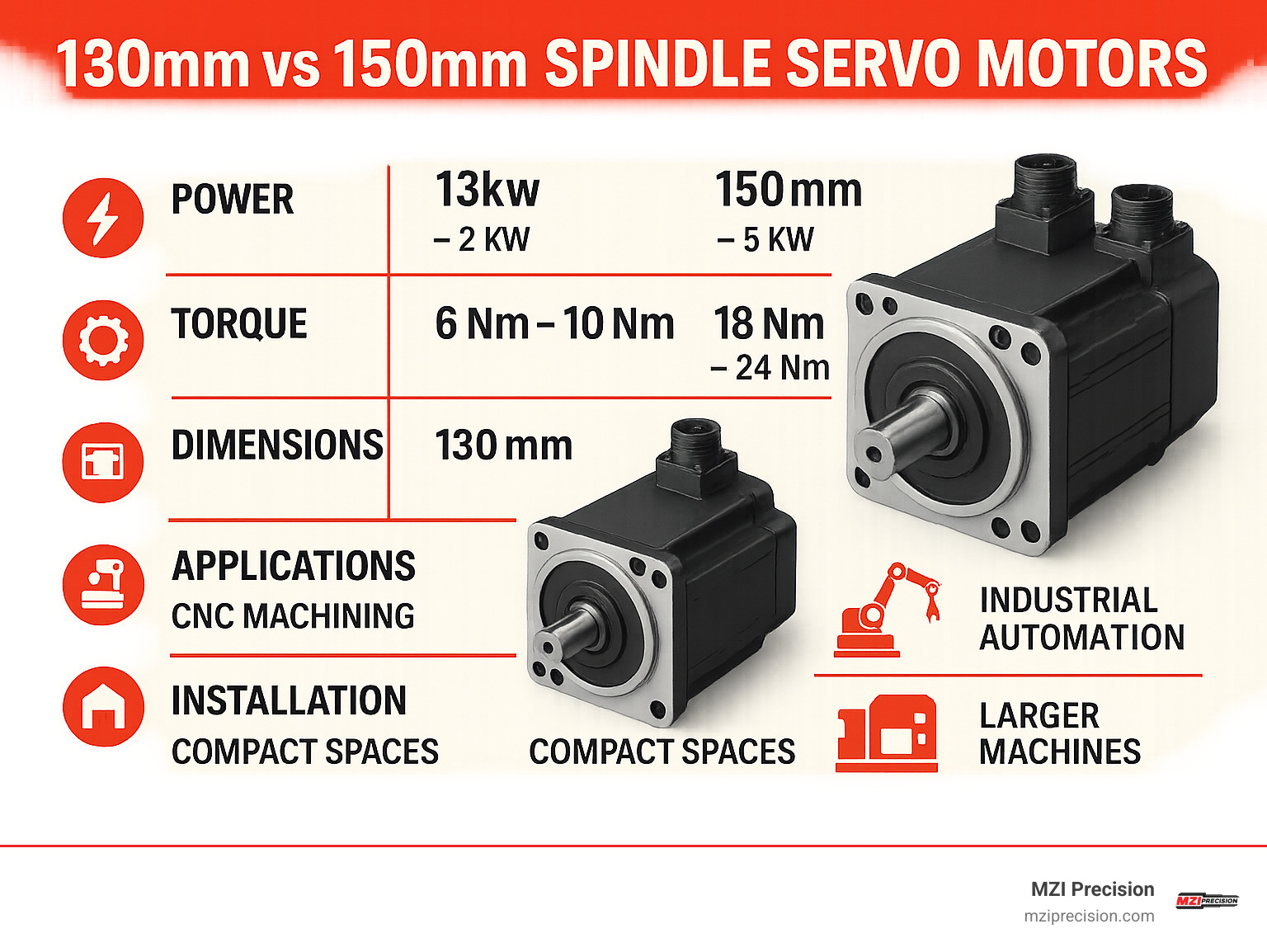
The fundamental difference between these two sizes goes beyond just the flange diameter. A 150mm motor has more room inside for larger windings and a beefier rotor, which translates directly into more power and torque capability. But with that extra muscle comes additional size, weight, and cost considerations.
| Specification | 130mm Spindle Servo Motor (Typical) | 150mm Spindle Servo Motor (Typical) |
|---|---|---|
| Rated Power | 1kW – 2.6kW | 2kW – 7.5kW+ |
| Rated Torque | 4Nm – 10Nm | 10Nm – 30Nm+ |
| Rated Speed | 1000 RPM – 2500 RPM | 1000 RPM – 3000 RPM |
| Peak Torque | Up to 20Nm | Up to 60Nm+ |
Power, Torque, and Performance Output
Here’s where the rubber meets the road – or in our case, where the cutting tool meets the workpiece. The performance gap between these two motor sizes is substantial and worth understanding in detail.
Rated power comparison shows that while a 130mm spindle servo motor typically tops out around 2.6kW, a 150mm motor often starts where the 130mm leaves off. We’re talking about 2kW to 7.5kW or even higher power ratings. This isn’t just a numbers game – this extra power directly impacts your material removal rate and your ability to maintain cutting speeds under heavy loads.
Rated torque comparison reveals an even more dramatic difference. Where a 130mm motor might provide 4Nm to 10Nm of continuous torque, a 150mm motor typically delivers 10Nm to 30Nm or more. This extra torque means you can apply greater cutting force without the motor stalling or losing precision.
Peak performance scales up proportionally. While a 130mm motor might deliver up to 20Nm of peak torque for those demanding moments when you’re breaking through tough material, a 150mm motor can provide 60Nm or more. This translates to better performance during rapid acceleration, heavy roughing cuts, or when your spindle encounters unexpected resistance.
For aerospace manufacturers working with titanium or Inconel, or any application requiring aggressive material removal, these performance differences can make or break your production schedule.
Physical Footprint and Machine Integration
Now let’s talk about the elephant in the room – or should we say, the motor in the machine enclosure. The physical implications of choosing a larger motor go well beyond just the flange diameter.
Installation dimensions become a critical factor when retrofitting existing equipment or designing new systems. A 150mm motor doesn’t just have a larger flange – it typically comes with a longer body, larger shaft diameter, and requires more robust mounting hardware. If you’re working with tight space constraints in your machine design, a 130mm spindle servo motor might be your only viable option, regardless of the power advantages of the larger size.
Weight considerations affect more than just shipping costs. A typical 1kW 130mm motor might weigh between 7.7kg and 10.2kg, while a comparable 150mm motor with higher power ratings will be significantly heavier. This extra weight impacts your machine’s overall balance, requires stronger mounting structures, and can affect the dynamic performance of moving machine components.
Machine compatibility becomes especially important when you’re retrofitting older equipment. We’ve seen plenty of situations where a shop wants the extra power of a 150mm motor, but their existing machine simply can’t accommodate the larger size without major modifications.
How to Select the Right Motor for Your Application
Choosing between these motor sizes isn’t about picking the most powerful option – it’s about finding the perfect match for your specific needs. Here’s how we approach this decision-making process with our customers.
Application analysis starts with understanding what you’re actually trying to accomplish. Are you machining aluminum aerospace parts that require high-speed cutting with moderate loads? A 130mm spindle servo motor might be perfect. Are you roughing out large steel forgings that demand maximum torque and power? You’ll probably need that 150mm motor.
Load calculation requires some homework, but it’s worth the effort. You need to calculate the actual torque and power demands of your spindle system, including the inertia of your spindle and tooling, friction losses in bearings and seals, the cutting forces involved in your typical operations, and the acceleration rates you need for optimal cycle times.
Required precision is often more about the overall system design than just motor size. Both 130mm and 150mm motors can deliver exceptional precision with the right encoder and servo drive. However, an undersized motor struggling under heavy loads will never maintain the precision you need, no matter how good its feedback system is.
Machine size and available mounting space often make the decision for you. Measure your available space carefully, and don’t forget to account for the servo drive, cooling systems, and cable routing that come with your motor choice.
Budget considerations extend beyond the initial purchase price. While larger motors typically cost more upfront, choosing an undersized motor can lead to frequent repairs, poor surface finishes, and production delays that cost far more in the long run.
Future needs deserve serious consideration too. If your production requirements might expand, or if you’re planning to machine tougher materials down the road, investing in a slightly oversized motor now could save you from costly upgrades later.
The goal is finding that sweet spot where your motor provides sufficient power and torque for your application, fits comfortably within your machine’s physical constraints, and delivers the precision and reliability your production demands. Sometimes that means choosing the compact efficiency of a 130mm spindle servo motor, and sometimes it means going bigger.
Conclusion
When you’re navigating industrial manufacturing, finding the right balance of precision, power, and reliability can feel like solving a complex puzzle. The 130mm spindle servo motor represents one of those perfect pieces that fits just right in many manufacturing scenarios.
Throughout our exploration, we’ve uncovered what makes these motors so valuable in today’s manufacturing landscape. Their impressive specifications – delivering anywhere from 1kW to 2.6kW of power with torque outputs ranging from 4Nm to 10Nm – provide the muscle needed for demanding applications. Meanwhile, their sophisticated feedback systems, whether using 2500 PPR incremental encoders or high-resolution 17-bit absolute encoders, ensure the precision that modern manufacturing demands.
The versatility of a 130mm spindle servo motor shines through its applications. From CNC milling operations that require pinpoint accuracy to automated production lines that need consistent, reliable performance, these motors have proven their worth across countless industrial settings. Their superior efficiency, precise position control, and excellent dynamic response give them a clear edge over traditional stepper or induction motors.
We’ve also seen how the servo drive acts as the motor’s trusted partner, providing essential features like multiple control modes, rapid response frequencies, and comprehensive protection systems. These built-in safeguards – protecting against overcurrent, overvoltage, and thermal overload – aren’t just nice-to-have features; they’re your insurance policy against costly downtime.
The choice between a 130mm spindle servo motor and its larger 150mm cousin ultimately comes down to your specific needs. While the 150mm offers more raw power and torque for heavy-duty applications, the 130mm excels when space is tight or when your power requirements fall within its sweet spot. It’s not about which motor is better – it’s about which one fits your unique situation perfectly.
Performance optimization goes beyond just picking the right motor. Even the most robust industrial manufacturing spindle will eventually need attention. Regular maintenance and prompt professional care when issues arise can mean the difference between a minor service interruption and a major production shutdown.
At MZI Precision, we’ve built our reputation on understanding these intricate systems inside and out. Our expertise in industrial manufacturing spindle repair and rebuilding means we can often bring your equipment back to like-new performance, extending its life and protecting your investment. We’ve worked with manufacturers across aerospace, defense, solar energy, and many other industries, and we know how critical it is to keep your operations running smoothly.
When your 130mm spindle servo motor or spindle assembly needs expert attention, you don’t have to face costly replacements or extended downtime. Our team specializes in industrial manufacturing spindle rebuilding that restores your equipment to peak performance.